Typical coding context
Source, build, test, text
- Firmware and application code
- Build output and test results
- Software logs and stack traces
Infrastructure for AI hardware development
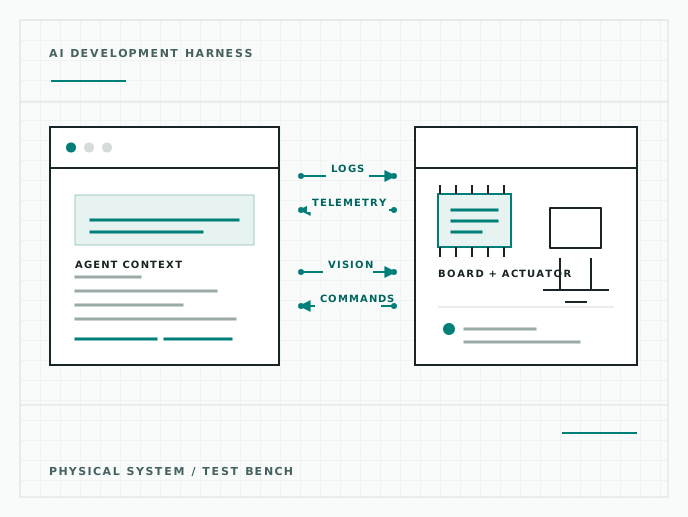
A controlled interface for the logs, telemetry, vision, and commands that connect an AI development harness to real embedded systems, boards, and machines.
The gap
Current coding agents can inspect repositories, modify firmware, run software tests, and reason over text logs. But a connected board, a moving actuator, or a controller fault is usually outside their field of view.
When the machine differs from the simulation, the development loop still depends on an engineer to collect state, interpret evidence, and trigger the next diagnostic step.
Typical coding context
Missing physical context
The interface
The tools expose the evidence and controls an AI development harness needs to participate in a physical engineering loop—without presenting the system as an unrestricted autonomous operator.
Integrate the inputs engineers already trust. Let the harness correlate logs with live state, camera observations, and bounded diagnostic commands.
Follow the development loopCapability surface
Four interfaces designed to make physical-system state useful in an AI-assisted development workflow.
01
Turn raw serial, boot, and diagnostic output into structured evidence an AI agent can reason about. Surface crashes, unexpected state transitions, timing anomalies, and recurring failures across boards and custom microcontroller hardware.
Example Correlate a watchdog reset with the code path that preceded it.
02
Make sensor readings, motor state, position, velocity, temperature, battery condition, error codes, and controller state available to the harness. Give the agent the same observable system context used to understand a running machine.
Example Diagnose an intermittent stop from encoder, current, and controller signals.
03
Expose programmatic, policy-bounded operations for diagnostics and test automation: configure a device, trigger a test, start or stop an operation, move an actuator, or change an approved operating parameter.
Example Trigger a repeatable diagnostic sequence after an anomalous reading.
04
Use cameras and image-recognition interfaces to let the harness inspect the physical environment. Check component presence, observe a robot, identify state changes, and detect behavior that logs alone cannot explain.
Example Confirm that a mechanical action occurred before evaluating the next test step.
Development loop
An AI harness works within the engineering loop by receiving physical context at each point where a code-only workflow would otherwise stop.
Designed for integration
Designed to integrate with the hardware and development environments engineers already use—not to promise universal compatibility out of the box.
Engineering organizations
For teams responsible for the full path from silicon, board, or mechanism to production-grade software. The interface is intended to support disciplined evidence gathering—not replace engineering judgment.
Discuss your workflowStart a technical conversation
Tell us about the hardware, test environment, and development workflow you want an AI harness to understand. A technical conversation starts with the constraints that matter.
Fields marked are required.